jueves, 31 de mayo de 2018


                                                          TASK ANALYSIS

WHAT IS TASK ANALYSIS?
A task analysis is a fundamental tool for teaching life skills. It is how a specific life skill task will be introduced and taught. The choice of forward or backward chaining will depend on how the task analysis is written.

A good task analysis consists of a written list of the discrete steps required to complete a task, such as brushing teeth, mopping a floor, or setting a table. The task analysis is not meant to be given to the child but is used by the teacher and staff supporting the student in learning the task in question.


TO BE CONSIDERED IN A TA
Three levels of knowledges:
ü  FACTUAL
ü  CONCEPTUAL
ü  PROCEDURAL
ü  METACOGNITIVE


Task analysis is one of the most effective ways to teach elementary, secondary, and even college students to thoroughly complete an assignment and master a skill(s). This article highlights everyday activities that can be broken into component parts to reach a specific learning goal.

Task analysis, in simple terms, is a process that breaks down an activity into smaller parts. By using task analysis in the classroom, teachers find that goals are more easily reached and that students are more likely to recall material at a later date. Sequences or steps are followed and practiced, making complex goals more attainable and hazy directions clearer!


miércoles, 30 de mayo de 2018


TOPIC: TEACHING WITHOUT THEACHING BY ROBERTO GUZMAN


In this talk Roberto discusses his three phase system which he uses to teach English without teaching English, to improve the learning experience for students and the teaching practice for professors.

Roberto mentioned about the importance of the analyzing, to synthesis and evaluate and think in a new language, he developed a system called Teaching without Teaching English which evolve into the language whenever they listen a conversation, tape and they have to identify if the people are specific when they are talking about that can help in the develop of comprehension, the second one is detect logical fallacies that can make the reasoning process, and the last one is identify levels of cognition. Roberto mentioned about that one important thing in his way of teaching is let his students to make mistakes in order to provide a better learning, and also let them use Spanglish, and also to have an idea of a word or about how to pronounce it after a time students will start to learning, thinking and speaking in English spontaneously and also they realize that they can make mistakes and learning in this way.

The only way of learning is understanding the language is a wonderful living thing and also that there is no way that someone can learn a language by simply memorizing rules by concentrating only in grammar but also when students are comfortable making mistakes the exchange in the classroom become so much more dynamic.


WHAT IS THEORETICAL FRAMEWORK?

The theoretical framework is presented in the early section of a dissertation and provides the rationale for conducting your research to investigate a particular research problem.

Consider the theoretical framework as a conceptual model that establishes a sense of structure that guides your research. It provides the background that supports your investigation and offers the reader a justification for your study of a particular research problem. It includes the variables you intend to measure and the relationships you seek to understand. Essentially, this is where you describe a “theory” and build your case for investigating that theory.

The development of the theoretical framework helps to clarify your implicit theory in a manner that is more clearly defined.  It helps you to consider other possible frameworks and to reduce biases that may sway your interpretation. The theoretical framework is how you conceptualize the nature of your research problem, its basis and the analysis you will choose to investigate that problem. This framework determines how you perceive, make sense of, and interpret your data.


lunes, 14 de mayo de 2018

Bloom’s Taxonomy

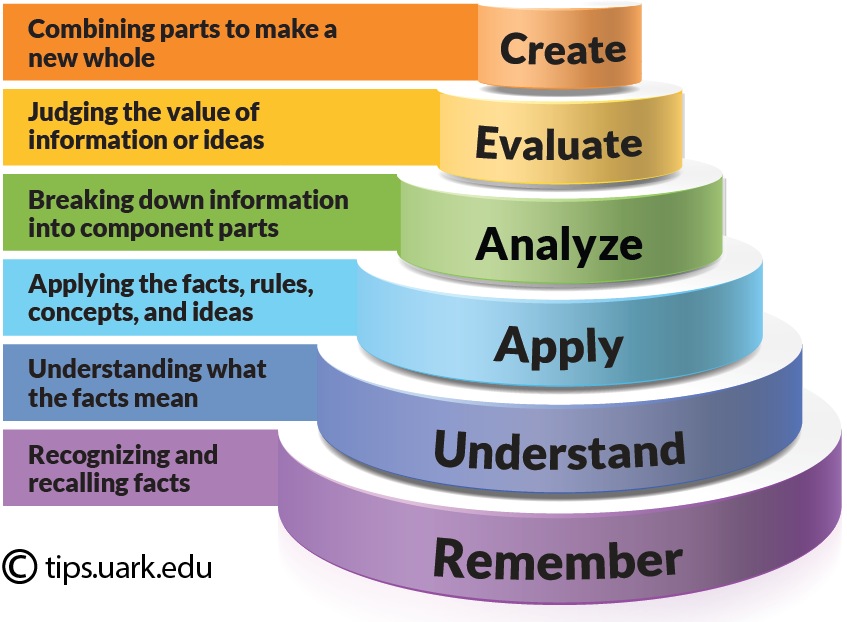
In 1956, Benjamin Bloom with collaborators Max Englehart, Edward Furst, Walter Hill, and David Krathwohl published a framework for categorizing educational goals: Taxonomy of Educational Objectives. Familiarly known as Bloom’s Taxonomy, this framework has been applied by generations of K-12 teachers and college instructors in their teaching.

The framework elaborated by Bloom and his collaborators consisted of six major categories: Knowledge, Comprehension, Application, Analysis, Synthesis, and Evaluation. The categories after Knowledge were presented as “skills and abilities,” with the understanding that knowledge was the necessary precondition for putting these skills and abilities into practice. 

The Original Taxonomy (1956)

Here are the authors’ brief explanations of these main categories in from the appendix of Taxonomy of Educational Objectives (Handbook One, pp. 201-207):

Knowledge 

“involves the recall of specifics and universals, the recall of methods and processes, or the recall of a pattern, structure, or setting.”

Comprehension

“refers to a type of understanding or apprehension such that the individual knows what is being communicated and can make use of the material or idea being communicated without necessarily relating it to other material or seeing its fullest implications.”

Application 

refers to the “use of abstractions in particular and concrete situations.”

Analysis 

represents the “breakdown of a communication into its constituent elements or parts such that the relative hierarchy of ideas is made clear and/or the relations between ideas expressed are made explicit.”

Synthesis 

involves the “putting together of elements and parts so as to form a whole.”


Evaluation 

engenders “judgments about the value of material and methods for given purposes.”

Resultado de imagen para bloom taxonomy

The Revised Taxonomy (2001)

A group of cognitive psychologists, curriculum theorists and instructional researchers, and testing and assessment specialists published in 2001 a revision of Bloom’s Taxonomy with the title A Taxonomy for Teaching, Learning, and Assessment. This title draws attention away from the somewhat static notion of “educational objectives” (in Bloom’s original title) and points to a more dynamic conception of classification.

Why To Use Bloom’s Taxonomy?

The authors of the revised taxonomy suggest a multi-layered answer to this question, to which the author of this teaching guide has added some clarifying points:

* Objectives (learning goals) are important to establish in a pedagogical interchange so that teachers and students alike understand the purpose of that interchange.
* Teachers can benefit from using frameworks to organize objectives because
* Organizing objectives helps to clarify objectives for themselves and for students.
* Having an organized set of objectives helps teachers to:
1. “plan and deliver appropriate instruction”;
2 .“design valid assessment tasks and strategies”;and
3. “ensure that instruction and assessment are aligned with the objectives.”

Resultado de imagen para bloom taxonomy

lunes, 7 de mayo de 2018

The positive efects of using virtual classroom as a repository to support a face to face english teaching class at UTEC

The positive efects of using virtual classroom as a repository to support a face to face english teaching class at UTEC

A well-maintained virtual class should enable students of all learning styles to receive the best possible education, in a way that they may not in an exclusively lecture-based environment which tends to be focused on auditory learners only. If the resources on a virtual classroom do not cater to the needs of the students both in terms of their format (text files, audio files, videos etc.) and their content the Virtual classroom is effectively rendered useless as it does not add to the students’ learning experience. It should contain just enough information to allow students to reinforce their work in lectures and gain a broader and deeper understanding of the subject, preferably through a range of presentational styles.

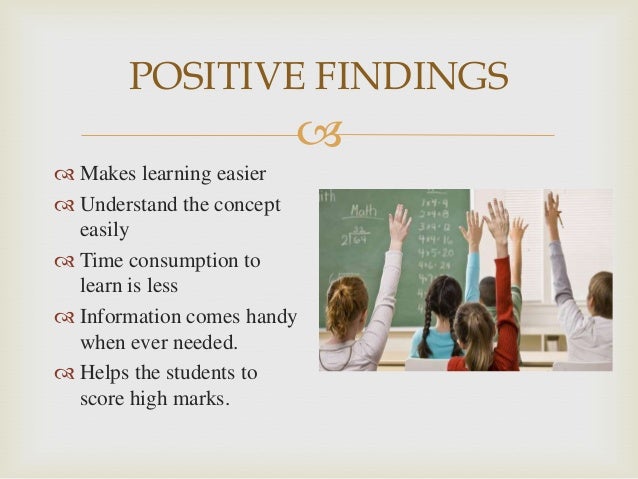
Resultado de imagen para positive effects of using a virtual classroom

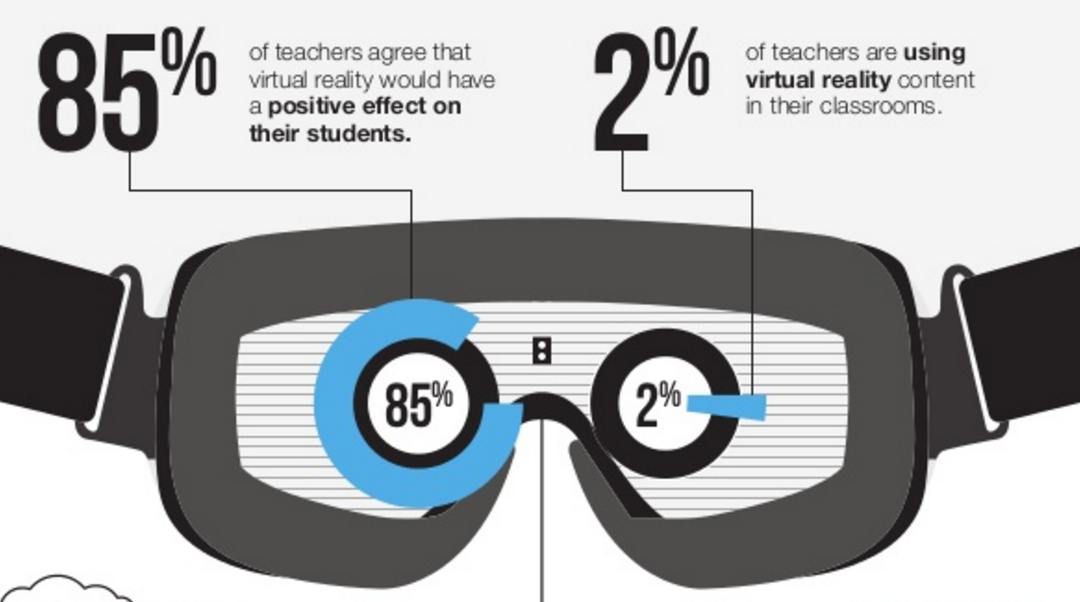
as you can see there are many positive effects based on researchs made by students in different áreas

Resultado de imagen para positive effects of using a virtual classroom


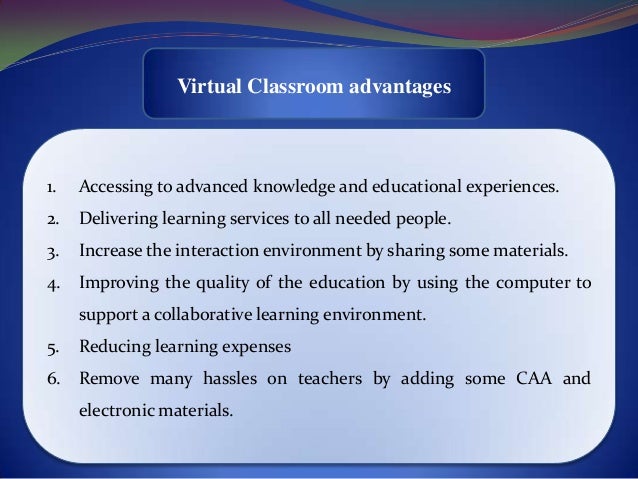
Traditionally, the school has been the place where learners and teachers meet each other day for the purposes of instilling knowledge. However, with the advent of computer technologies in the early 1990s, many products and solutions have been developed to fully exploit the internet. Since then, virtual learning environments  have emerged to supporting teaching and learning activities across the internet. These days, we have something called the virtual classroom

Resultado de imagen para advantages and disadvantages a virtual classroom

there are different steps to create a virtual classroom

lunes, 30 de abril de 2018

FIFTH CLASS TBI


  • TASK BASED INSTRUCTION (TBI)
Task‐based instruction is characterized by activities that engage language learners in meaningful, goal‐oriented communication to solve problems, complete projects, and reach decisions. 


CONTENT BASED INSTRUNCTIONS (CBI)
What is content-based instruction?
The focus of a CBI lesson is on the topic or subject matter. During the lesson students are focused on learning about something. This could be anything that interests them from a serious science subject to their favourite pop star or even a topical news story or film. They learn about this subject using the language they are trying to learn, rather than their native language, as a tool for developing knowledge and so they develop their linguistic ability in the target language. This is thought to be a more natural way of developing language ability and one that corresponds more to the way we originally learn our first language.

What does a content-based instruction lesson look like?
There are many ways to approach creating a CBI lesson. This is one possible way.
  • Preparation
    • Choose a subject of interest to students.
    • Find three or four suitable sources that deal with different aspects of the subject. These could be websites, reference books, audio or video of lectures or even real people.
  • During the lesson
    • Divide the class into small groups and assign each group a small research task and a source of information to use to help them fulfil the task.
    • Then once they have done their research they form new groups with students that used other information sources and share and compare their information.
    • There should then be some product as the end result of this sharing of information which could take the form of a group report or presentation of some kind.

What are the advantages of content-based instruction?
  • It can make learning a language more interesting and motivating. Students can use the language to fulfil a real purpose, which can make students both more independent and confident.
  • Students can also develop a much wider knowledge of the world through CBI which can feed back into improving and supporting their general educational needs.
  • CBI is very popular among EAP (English for Academic Purposes) teachers as it helps students to develop valuable study skills such as note taking, summarising and extracting key information from texts.
  • Taking information from different sources, re-evaluating and restructuring that information can help students to develop very valuable thinking skills that can then be transferred to other subjects.
  • The inclusion of a group work element within the framework given above can also help students to develop their collaborative skills, which can have 

Research questions and more MAPs


OBSERVE-HYPOTHESIZE-EXPERIMENT   “OHE”

Michael Lewis claims that students should be allowed to Observe (read or listen to language) which will then provoke them to Hypothesize about how the language works before going on to the Experiment on the basis of that hypothesis.
In his own teaching design, Lewis proposes a model that comprises the steps, Observe-Hypothesize-Experiment, as opposed to the traditional Present-Practice –Produce paradigm. Unfortunately, Lewis does not lay out any instructional sequences exemplifying how he thinks this procedure might operate in actual language classrooms.
 FIVE E´

The e5 Instructional Model is a reference point for school leaders and teachers to develop a deeper understanding of what constitutes high quality teacher practice in the classroom. The model consists of five domains:
1. Engage
2. Explore
3. Explain  
4. Elaborate
5. Evaluate                          


LEXICAL APROACH
 It has lexically based theory of language
 It doesn´t have any certain learning theory
 It is an alternative approach
It focuses on words and word combinations
Grammar and lexis are the heart of learning
It aims to teach vocabulary within grammar
Teachers help learners to discover knowledge instead of giving it directly


“TYPES OF RESEARCH QUESTIONS”


Quantitative Question Types

Quantitative research is typically used to determine how, what, when, and where. Questionnaires for quant research are in many ways easier to develop than qual, as once you determine what you need to learn, incorporating those questions into multiple choice, single-select, grid questions, and so on, is more intuitive. Because it’s gathering larger data sets of answers, quantitative methodologies include research questions that are typically more specific:


  1. Descriptive Questions: Seek to describe the concept or topic in question. An example of this type would be understanding the usage of a product like the frequency, time of day, the purpose of use, etc.
  2. Comparative Questions: Used to analyze the difference between two groups, concepts, or other variables. Examples of these types of questions include comparing the frequency of use between two products, men versus women’s preference for brands, etc.
  3. Relationship-Based Questions: Or in some cases causal-based— these questions work to understand how one variable influences another, like how color influences the desire to purchase a particular product.

Qualitative Question Types
Qualitative research is less quantifiable in nature and focuses more on discovering, understanding, and exploring meaning when it comes to an objective. Qual research questions are less direct and far vaguer in nature:

  1. Exploratory Questions: Similar to descriptive questions in quant research, this form of question looks to understand something— without influencing the results with preconceived notions. For example, asking how a product is used or perceptions around a certain topic are two types of exploratory questions.
  2. Predictive Questions: As the name entails, these questions seek to understand the intent or future outcome surrounding a topic or action. An example of this type of question would include asking why a consumer behaves in a certain why or how they’d feel if a certain situation were to take place.
  3. Interpretive Questions: Look to gather feedback on a certain topic or concept without influencing the outcome. For example, testing new product concepts and understanding how messaging claims are interpreted would fall under this type.

Well written questions, regardless of the methodology, provide an easy to understand outlet for respondents to provide their answers. They should not only answer objectives but also identify problems and opportunities. The types of questions above can be used to guide the objectives and the key question of the research or be implemented throughout a questionnaire in order to provide the most relevant insights.


 Watch the video recommended to understand qualitative research questions:

domingo, 22 de abril de 2018


THIRD CLASS-ENTRY
TEACHING METHODS
   1. Presentation, Practice, and Production
    2. Engage-Study-Activate (ESA)
    3. TEST TEACH TEST APPROACH
   1. Presentation, Practice, and Production
Presentation – Practice – Production, or PPP, is a method for teaching structures (e.g. grammar or vocabulary) in a foreign language. As its name suggests, PPP is divided into three phases, moving from tight teacher control towards greater learner freedom. Note that some writers1 use the name to refer to a specific method that focuses on oral skills, but it can also be applied more broadly to a family of related methods which rely on the progression from presentation, through controlled practice, to free production.

In this class the group presented some activities using  (ppp method), in the first  stage they used different resources according to the topic SIMPLE PAST such as  visual aids, class participation and short oral presentation of some students.
In the second stage about practice the teachers included drills, multiple-choice exercises, gap-and-cue exercises, transformations etc. And they role is to direct the activities, to provide positive feedback to students, correct mistakes and model the correct forms.In the production stage the teachers emphasis on accuracy (, whereas the production phase is supposed to develop fluency (the ability to speak naturally).
    2. Engage-Study-Activate (ESA)
Engage-Study and Activate are elements which are present in a language classroom to help students to learn effectively.
For this presentation the group used activities in relation to the topic  simple past vrs  past  continuos such as class participation, some exercises to resolve infront of the class, dynamics activities  using the correct structures.


3. TEST TEACH TEST APPROACH
Test, teach, test (TTT) is an approach to teaching where learners first complete a task or activity without help from the teacher. Then, based on the problems seen, the teacher plans and presents the target language. Then the learners do another task to practise the new language.
In this class the group used different techniques according to the method, using the topic daily activities, they developed the techniques where the students participated in front of the class such as dialogues, dynamics and grammar structures.